Regular saving and investing is one of the pillars of building wealth.
What is the 50-30-20 rule?
It’s a widely known personal finance and budgeting method, popularised by Elizabeth Warren and Amelia Warren Tyagi in their book All Your Worth, that helps you divide up your net income. It separates three main spending groups.
Needs - 50%
This covers everything essential for survival. Food, housing, utility bills. In many cases, transport and healthcare costs belong here too.
Wants / Personal spending - 30%
Spending that isn’t vital, but is part of a fulfilling lifestyle: entertainment, new clothes when you still have plenty to wear, hobbies, gadgets, dietary supplements, subscriptions. I know it can sometimes be debatable where to draw the line between a need and a want. My compass: could I keep living and working safely without it? If yes, then it’s a want.
Savings and debt repayment - 20%
This covers building an emergency fund, saving for retirement and long-term investments. And before all of these, paying off debt beyond the minimum payments.
Anything goes into this category if the answer is yes to the question: does it increase our future financial security?
Buying lottery tickets is not a high-risk investment, so it doesn’t go here.
Why bother grouping at all?
A common technique among financially conscious people is to decide in advance what we’ll spend a given amount on. This way, our spending will be shaped much more by our goals than by cleverly crafted direct or indirect advertising.
It’s important that this is far from the same as deprivation or stinginess. Someone can assign a considerable amount to the wants category if that fits their financial goals.
When we were talking about building savings, someone told me: what’s the point, you can’t take it with you to the grave anyway. Well, I don’t know about them, but I’m still counting on a few more years before the grave. Until then, though, savings mean security and more freedom of choice. To me, these matter more than one extra holiday.
One of my favourite ideas comes from Morgan Housel (author of The Psychology of Money): he sees saving as a way to buy independence.
Don’t get me wrong, there’s nothing wrong with people who care more about collecting experiences whenever they can, while they still can. Everyone is responsible for their own life and happiness. I function better when I’m not afraid and when I have more freedom. And for that, a basic level of financial security helps.
So why don’t I use the 50-30-20 rule?
The truth is, there are a lot of life situations where this ratio isn’t the practical one. I’ve hardly ever had a stage of life when I actually used it.
When I had no income or only very little (e.g. a HUF 100,000 scholarship, about €250 a month), my basic needs covered almost the whole amount. Even then, I still put some aside, for the bare minimum of security. And later, for example during my sabbatical, I had a small regular investment that I didn’t want to interrupt.
But when I was earning well, I put aside even more. There was a period when I saved half my salary. This was useful because the maths was simple. In one year, I could buy myself a year of freedom. Of course, this only worked because, by the book, I set the money aside at the start of the month and used a spending tracker to make sure I stayed within the remaining budget.
Instead of specific ratios, it’s worth experimenting to find the minimum amount that’s enough for a normal life. You don’t have to save everything that’s left; you can add a healthy “wants budget” on top. From what remains, you can roughly work out how long it will take to reach a given goal. Just make sure that as your income grows, you also divide the extra according to your goals.
Grouping can still be useful
Although sticking to exact ratios isn’t always the goal, grouping spending into needs, wants and savings can still be useful. For example, when my income was very low, after a few months it became clear that the only way to build an emergency fund was to take on a second job or change jobs. If your needs regularly take up more than 50%, that’s a sign that something is worth changing.
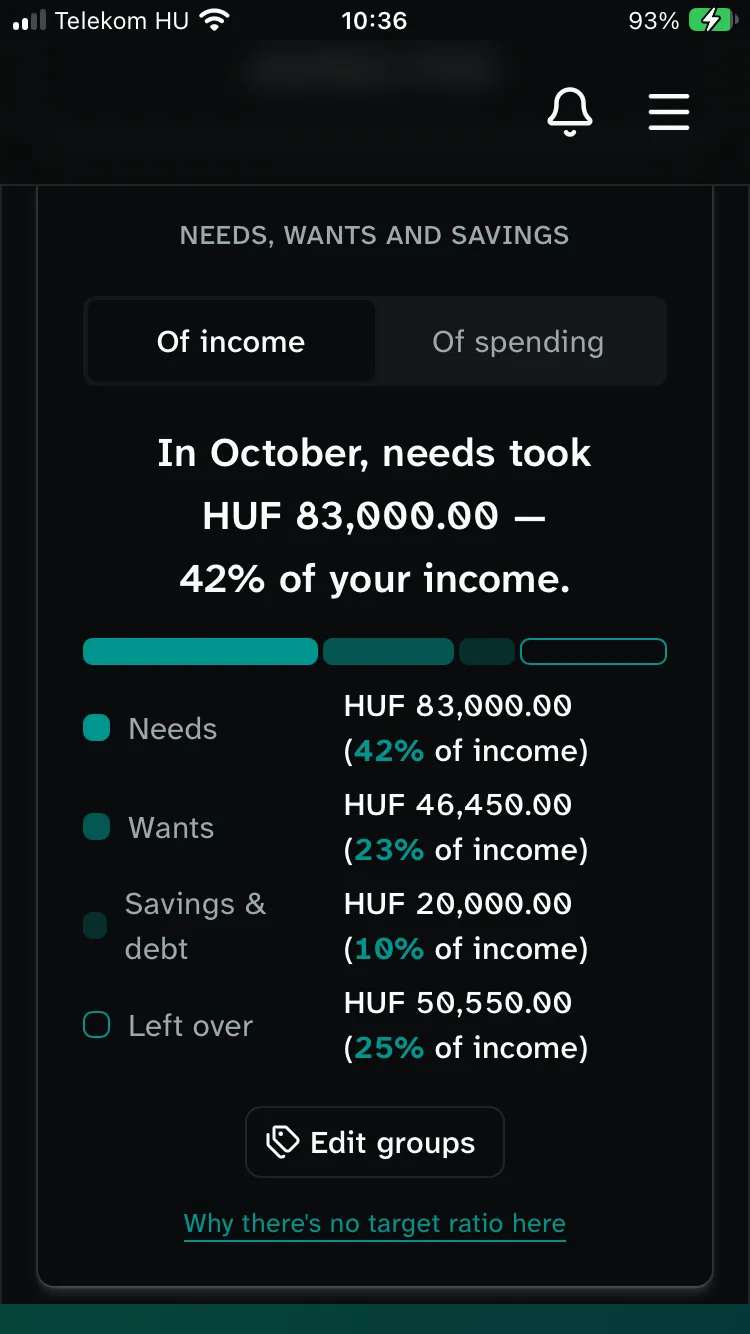
For me, keeping a budget actually meant comfort. I didn’t have to look at prices while I was still far from the limit. And when I got close to it, it was easier to make the right call about what actually matters less than my future.
References
Warren, E., & Warren Tyagi, A. (2005). All your worth: The ultimate lifetime money plan. Free Press.
Housel, M. (2020). The psychology of money: Timeless lessons on wealth, greed, and happiness. Harriman House.
- budgeting
- saving
- planning